Monday, September 6, 2010

Tribute to Yankee


Yankee was a friend's beautiful German Shepherd. He lived a good life and was dearly loved. I house-sat for him a few times and he was always ready to please. As he grew older, he became deaf making it hard for him to know what was happening around him.


                                      ANDACHT ALPHA YANKEE

                                                       “YANKEE”


                               28th September 1997 – 24th August 2010


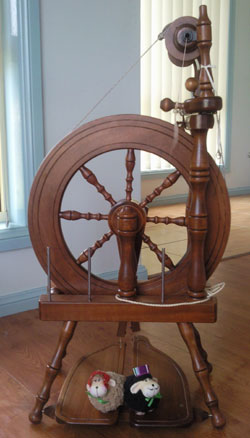
Treadle Spinning Wheel V Electric Spinner

When it comes to choice of spinning wheel, there are many factors to take into consideration before you purchase. With dozens of wheels to choose from, it can be a difficult decision. The spinning wheel you choose depends on a number of factors.

What are you wanting the wheel to achieve? This will decide whether you buy a treadle wheel, upright, traditional, portable, or an electric spinner.

Do you want relaxing spinning, production spinning, or to enable the continuation of spinning with some kind of physical impairment?

Spinning wheels differ greatly in their action, some being very easy to use while others require more attention. As rule of thumb, a spinning wheel with a bigger wheel diameter is easier to treadle with less effort than a smaller wheel diameter, while the electric spinner requires no treadling at all. Wheels are no longer cheap to buy, some running to many hundreds of dollars therefore careful choice, and road-testing (where possible) is essential.

For fast or production spinning the electric spinner is at the top of the list. All one has to do is set the speed of the whorl and feed the carded wool into the orifice. It will keep turning until you switch it off. Not having to treadle, fast production will ensue though it needs careful tensioning as some electric spinners can tend to 'over spin'. The plus side is that a very even yarn can be achieved in a relatively short space of time. The speed can be increased or decreased by the twist of the button, although this will take one hand away from the drafting of the wool. A foot pedal option is available for on/off functions.

By its very nature, a treadle spinning wheel is slower than the electric spinner, even though the whorl can be travelling at the same speed. Just having to treadle will make a difference, but that can be a plus. A treadle spinning wheel can be better utilised by using your foot to dictate the speed it travels. When creating fancy yarns, it is essential to have total control of your wheel to enable the even distribution of twists to the yarn. Some of the smaller wheel diameter spinning wheels are good for spinning fine yarn, while others with larger wheel diameter are better suited to the heavier wools. Choices between the ‘upright’ wheel or a ‘traditional’ wheel are personal. If, for instance one has foot, leg or back problems, using an upright wheel is easier as one can sit evenly in front of the wheel and use either foot for treadling. A traditional wheel dictates the right foot must be used or one will sit twisted if trying to use the left foot to treadle.

I have three spinning wheels, and each spins very differently.


My Little Peggy was bought in the early 1980's when I was living in New Zealand. It is an excellent spinning wheel and spins fine yarn easily.  The treadling action is smooth, although with the smaller 14" wheel, treadling is not as easy as with a bigger 18" or 20" wheel, having to 'treadle' more to achieve the same output. It's structure is solid with excellent workmanship, well balanced and pleasant to the eye. This wheel is small enough to take with you to spinning events. For lace and fine threads, a spinning wheel with a smaller diameter is more suitable than a large one. It has a range of ratios making it very flexible.

Although Rappard is no longer producing these wheels, they are still very much sought after. Mine is safely tucked away, though in need of a little 'refurbishment' due to tropical conditions and damage to the finish.

The Ashford Traveller, although still an upright, has a much larger wheel than the little peggy. This wheel spins a good yarn but is more suited to normal to heavier yarn such as 4ply, double knit and bulky. It does not like the fine yarn plying and tends to vibrate when treadling fast, making it noisy and uncomfortable to use. My wheel has a double treadle, but its possible to use just one and not both - I spin with my left foot only due to leg damage in a car accident many years ago and it works very well. If treadling becomes too much work, the electric spinner is another option.

Because of the characteristics of vertical upright and horizontal traditional, I would have to sit twisted if using my left foot on a traditional wheel, hence my preferred use of the upright wheel.

Compare this with the electric spinner...


The Roberta is an excellent example of the electric spinner and quite popular, although at the top of the price range. It spins efficiently, evenly, is fast and easy to use. I enjoy this spinner when I don’t feel like having to treadle, but on the other hand it does need an electric outlet if I take it with me to spinning events.The finish is superb and it runs like a dream once it's 'broken in'. As this wheel has bearings it doesn't need oiling, but when new it has to be worn in through letting leaving it turned on and the flyer going for a while. And a little on the flyer does help at times. The bobbins need to be worn in, then it should not 'pull' the fibre out of your hands. If it does, something needs adjusting or out of alignment - as happened with mine. I sent it back and was told it had not been put together correctly. So, the spinner was duly re-aligned, free of charge, and now it works beautifully.

A new 'mini spinner' is now on the market and is worth a tryout. There are many brands of electric spinners and spinning wheels on the market and personal preference, as well as price, will dictate the model bought.

Treadle V Electric spinner - whichever spinner you choose, it will give many hours of pleasurable spinning.

Happy spinning!


Tour de Fleece

For those who think I have gone totally balmy talking about a 'Tour de Fleece' - no, I haven't.

The Tour de Fleece is a spinning competition that runs alongside the Tour de France, and this year started on 4th July and ending on the 25th July, with the same rest days in between. The idea of the competition is to give yourself a goal with spinning, whether it be just sitting for longer at your wheel, creating a new designer thread, spinning that kilo of fleece you've been putting off, or sitting and watching the Tour de France and spinning at the same time. Prizes were awarded in different areas of spinning at the end of the competition.

For me, to sit and spin at the same time as watching the Tour de France, it was late at night as France is a long way from Australia and the time zone is hours apart - but it was fun and it did happen...


Those who enter the Tour de Fleece, and there ended up being about two and half thousand members on that Ravelry forum, it was be an exciting three weeks. All the more so if you live in France somewhere along the tour route. Weather permitting, spinning could be undertaken on the side of the road as the cyclists pass - now That would be different and something to keep in mind should I have the opportunity to be in France at that time.

Somehow, I've ended up as team leader and as I'd never entered an event like this, or led a team before, it was a first for me and thoroughly enjoyed taking part. The Tour de Fleece has been going for a few years and seems to be growing each year. Spinning is becoming more popular and in France especially, its entered a 're-birth' as more people are again starting to spin.

It is truly an International Event in the crafting world, with some amazing results. Spinners from all parts of the globe took part, making friends, challenging themselves, and winning lots of lovely prizes.

Whether you spin on a wheel or a spindle, the fun is taking part and setting yourself your own goals for Le Tour. The colours, textures, amounts, the dyeing, the fleeces, it all adds up to one huge event. It must be the only event in the world where so many people get together and work for a common goal. Even the Olympics doesn't get this much coverage - most people cannot 'take part' in that event, only watch.

One of the best parts of this competition is the making of new friends, in all parts of the world. I am a member of quite a few groups on Ravelry, but one group in particular has caught my attention - Spinners of France. Maybe because I love that country, and its people, that I have become somewhat addicted to learning French for when I am over that way. Its a beautiful country, and now the art of spinning is in 're-birth' with hundreds of women, and probably some men, taking up the Wheel and spindle again.

Next they will need to look at their wool production, for use other than filling mattresses, creating roofing batts with the fibre or burning it as is happening with most of the fibre now. Sheep grown for their meat are the main animals and they do not create spinning fibre; their wool is coarse and no good for spinning so basically, a new industry will need to spring up for the spinners. Italy and Spain have the merino, the UK has many different breeds of sheep, and in time, France will follow suit. There are already a few small-holding farmers who tend the spinners market, and that is set to grow providing infrastructure is put into place for the industry.

For my part in Le Tour, I spun up some Shetland tops into a lace weight yarn, and when I have completed that, next will be coloured slubby tops that I also acquired at the Berry Wool Muster last weekend.

The original goal was to spin 1kg of fleece or tops into yarn in the three weeks of Le Tour de France, but it was a wee bit of wishful thinking... Other things always seem to get in the way of being able to sit and spin, i.e. eating, sleep, shopping, and other menial tasks that have to be done throughout the day. What a waste of time, when we ought to be spending it spinning!
 

First yarn hot off the bobbin!
To say that trying to spin, and watch Le Tour de France at the same time is challenging is an understatement - looking at two things at once is definitely different - if one looks down at the spinning, you miss anything going on along the road or seeing the magnificent countryside. If you watch the action on tv, you end up with globs of bubbly stuff that isn't meant to happen, running onto your bobbin. This is where we could do with two sets of eyes -  that would make things much easier.
The Tour will at least get me back into spinning mode, I have much to catch up on and once this is finished, will see about some fancy yarns and playing with dyes. That I have been planning to do for a while, and not quite gotten around to it. Now is as good a time as any - any time is a good time for fleece, spinning and dyeing.

Here, downunder in Australia, its dawned beautiful clear but cool days - and the spinning wheel was oiled and ready to go for the next session, which was... Start, of the mountain stage.


Handspun Lace Scarf in Merino/Silk

With a bit of a lag in activity after Le Tour de Fleece, I've managed to get myself back to 'The Blog' and put a few words on paper. Its been a busy time, completing the editing of a manuscript but that is now out of the way and I can concentrate on more important things - like my spinning and knitting.

The Shetland I spun for Le Tour has been stored for later use, I haven't decided on a project for it as yet but I'm sure something will crop up at some stage. The grey matter is already ticking over on that one. With only 250grams, its not really enough for a jumper, but might make a short sleeve summer cardigan...

Oh dear - think I just found a project for it. Whether to dye it or leave it natural white?

The yarn below is a beautiful purple Merino/Silk, which I've spun up in a medium lace weight. A pattern has been sourced and knitting has commenced.


As I have not used silk yarn as stated on the pattern, I decided on using larger needles as the yarn is not as fine, but it's still knitting up very nicely.


At the same time, I am also working on a cardigan for my daughter. The blue dyed sliver is to be blended with alpaca to spin into a fine slubby yarn.


So far, the corridale/alapca blend is spinning up beautifully with the first bobbin nearly complete.  It is a pleasure to spin.
To blend the fibres, I am using hand carders with 2/3rd sliver, 1/3 alpaca and carding until the white is fully blended, giving a 'denim' look to the yarn. One strand will have slubs of white alpaca, emulating the original yarn on the pattern as closely as possible.

In the meantime, the bath-tub has been full of fleece leftover from other projects and washed in preparation for carding.
If that isn't enough, the thought of knitting my granddaughter gloves and beanie is also on the cards...
And if there is any time left over, I will see about a bit of sleep and food here and there...


A Coat of Many Colours - Dog Rescue part 2

Millie looked a sorry sight when she was brought back to my daughter's house - her coat was very matted, hair falling into her eyes and the longest eye lashes I've even seen on a dog! She was very unsure and barked at everything. The lady that found her and looked after her brought her back from death's door, spending a lot of time to get her back to health.

After a few days in her new home she is starting to settle down, quite quickly in fact, and is already becoming part of the family.

An appointment was made for her at the Pamper Parlour to clean her up a little, so today she went in a ragamuffin and came out a fluffy little pooch. They had bathed and blow-dried her, trimmed her coat and removed all the tangles, of which it was all matted, cut back the hair on her face, and downsized the toe nails.

With the arrival of the new dog, along came the request 'can you make her a new coat?' So out come the needles and some dyed handspun yarn and I start knitting. After finding a basic pattern on the internet, I customised it by re-sizing and changing the neck shape. I decided on a simple rib to give a bit of extra warmth. It knitted up quickly, and I was surprised at how well the colours blended together. The dyeing of this skein was an experiment and I'm pleased with the result.

The dog coat is a success and looks beautiful on her. Now she is bathed and trimmed, the fluffy pooch is much happier, can see easier and is more mischievous than ever. Hopefully, she will fatten up a little with good food, plenty of love and attention, enough exercise, settle in and become part of the family for a long time to come.


One very smart little girl, all snug and warm.